This post contains affiliate links. We may earn a commission from purchases.
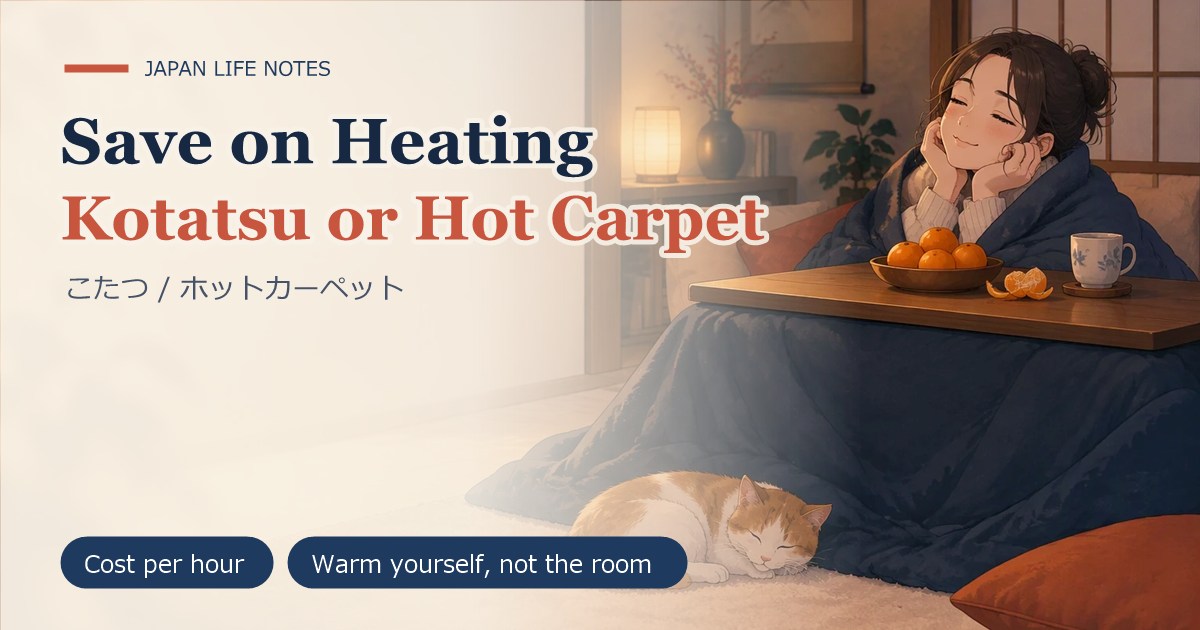
Winter in a Japanese apartment can be cold, and heating the whole room all day can make your electricity bill go up fast. Our answer as Japanese locals: warm yourself, not the whole room. A kotatsu (こたつ) or a hot carpet (ホットカーペット) uses much less electricity than a heater that warms all the air.
This guide explains why they are cheaper, how to estimate the cost, and how to use them with your air conditioner. We also share our favorite trick for using a kotatsu and a hot carpet together. It also covers the Japanese buttons on an air conditioner remote and the safety rules for kerosene heaters.
Our experience: In winter, we mostly use the air conditioner, but the air gets dry. With a kotatsu, our feet get warm quickly. It is so warm and comfortable that it is hard to get out, and sometimes we even fall asleep in it (please do not copy us; see the safety part below). A kerosene fan heater feels very warm, but buying and refilling kerosene is hard work. An oil heater is gentle, but it takes a long time to warm up the room.
- Why a kotatsu or hot carpet saves money
- Cost per hour: a rough guide
- How to estimate the cost yourself
- Kotatsu or hot carpet: which one?
- Our favorite trick: a kotatsu on a hot carpet, heater off
- Use them with your air conditioner
- Safety: low-temperature burns
- Air conditioner remote buttons in English
- Other heaters in Japan
- Summary
Why a kotatsu or hot carpet saves money
A heater that warms the whole room has to heat all the air, and warm air escapes through windows. A kotatsu warms only the small space under the table. A hot carpet warms the floor where you sit. Because they heat a small area close to your body, they need less power.
Both also have a thermostat. Once they are warm, the heater turns on and off by itself, so they do not run at full power all the time.
Cost per hour: a rough guide
Japanese appliance ads use a guide price of 31 yen per kWh (tax included, set in July 2022 by the Home Electric Appliances Fair Trade Conference). We use this price below. Your real price depends on your power company and plan.
| Type | Japanese | Cost per hour (guide) | Notes |
|---|---|---|---|
| Hot carpet (2 tatami size) | ホットカーペット | About 11 yen on high | Based on a Panasonic 2-jo model (580 W). See the note below. |
| Kotatsu (600 W heater) | こたつ | Up to about 19 yen | This is full power. The heater turns on/off, so the real cost is usually lower. |
| Oil heater / ceramic heater (1,200 W) | オイルヒーター / セラミックヒーター | Up to about 37 yen | Full power. Many models lower their power once the room is warm. |
| Air conditioner (heating) | エアコン 暖房 | Changes a lot | Depends on the model, room size, outside temperature, settings. |
Note on the hot carpet: Panasonic lists about 7.92 yen per hour on high for its 2-jo hot carpet DC-2KM (580 W), measured with its own cover and calculated at 22 yen per kWh (Panasonic spec page, Japanese). We recalculated it at 31 yen per kWh, which gives about 11 yen. On a lower setting, it uses less.
All numbers are rough guides, not exact costs.
How to estimate the cost yourself
Find the wattage (消費電力, shōhi denryoku) on the label or in the manual, then use this formula:
Watts ÷ 1,000 × hours × price per kWh = cost
Example: a kotatsu heater rated at 600 W, running at full power for 1 hour, uses 0.6 kWh. 0.6 × 31 = about 19 yen. Treat this as an upper guide. Some product pages also list the cost per hour (1時間あたりの電気代) for each setting, which is closer to real use.
Kotatsu or hot carpet: which one?
| Kotatsu | Hot carpet | |
|---|---|---|
| What it warms | Your legs, under a table with a blanket | The floor where you sit or lie |
| Good for | Eating, working, relaxing at a low table | Sitting on the floor, playing, reading |
| Space | Needs a table + a large blanket (futon) | Flat, so it fits under a rug |
| Watch out | Hard to get out. Do not sleep in it. | Do not sleep on it for a long time. |
For buttons, sizes and safety, read our kotatsu guide.
Our favorite trick: a kotatsu on a hot carpet, heater off
This is the way we recommend most. Put the kotatsu table on top of the hot carpet, and leave the kotatsu heater switched off. Only the hot carpet is on.
The kotatsu blanket (futon) works like a lid. It keeps the warmth from the hot carpet under the table, so your legs stay warm. You pay for only one heater, so it keeps the electricity cost very low, and it is still really warm. In our home, this is how we use the kotatsu in winter.
- Turn the kotatsu heater off. Using both heaters at the same time makes it too hot under the blanket and wastes electricity.
- Start on a low setting. Under the blanket, the heat stays in, so the hot carpet does not need to be on high.
- Keep the hot carpet controller outside the blanket. Some makers ask users not to let other heat reach the controller.
- Check your hot carpet manual first. Some manuals have rules about putting furniture or heating products on the carpet. Follow your manual.
- Do not sleep under it. It is very comfortable, but a long time on the same warm spot can cause a low-temperature burn.
Use them with your air conditioner
- Warm the room a little, warm yourself a lot. Use the air conditioner on a lower setting, and use a kotatsu or hot carpet where you sit.
- Point the airflow down. Warm air rises. In heating mode, pointing the airflow (風向) down can help warm the floor area. Check the manual for your model.
- Turn it off when you leave. A kotatsu or hot carpet only helps when you are using it. Use the timer or switch it off when you get up.
Safety: low-temperature burns
A kotatsu or hot carpet does not feel very hot, but touching the same warm spot for a long time can cause a low-temperature burn (低温やけど, teion yakedo). Do not sleep in a kotatsu or on a hot carpet. Be extra careful with older people, people who have had alcohol, and anyone who cannot easily move. Follow the safety notes in your manual.
Air conditioner remote buttons in English
In Japan, the same air conditioner is used for cooling in summer and heating in winter. The remote is often only in Japanese. These words are common on most remotes:
| Japanese | Reading | Meaning |
|---|---|---|
| 運転 / 停止 | unten / teishi | Start / Stop |
| 暖房 | danbō | Heating |
| 冷房 | reibō | Cooling |
| 除湿 | joshitsu | Dry mode (removes humidity) |
| 自動 | jidō | Auto |
| 温度 | ondo | Temperature |
| 風量 | fūryō | Fan speed |
| 風向 | fūkō | Airflow direction |
| 切タイマー / 入タイマー | kiri taimā / iri taimā | Off timer / On timer |
Other heaters in Japan
- Oil heater (オイルヒーター): quiet, gentle heat with no flame, but slow to warm a room and it can use a lot of electricity.
- Ceramic heater (セラミックヒーター): quick heat for a small spot, like a bathroom changing area. It uses a lot of electricity for its size, so use it for short times.
- Kerosene fan heater (石油ファンヒーター): strong, fast heat for a big room. You need to buy kerosene, and some rentals do not allow it. Read the safety rules below.
Kerosene heaters: safety rules
Kerosene (灯油, tōyu) heaters burn fuel inside your room. Before you buy one, check your rental contract or ask your management company whether kerosene heaters are allowed.
- Let fresh air in. Heater makers tell users to open a window 1–2 times per hour, for 1–2 minutes, because the heater uses the air in the room. (Source: Toyotomi manual, Japanese.)
- Turn it off before refueling. NITE (Japan’s product safety agency) asks users to always turn off the heater before adding kerosene.
- Never use gasoline. Putting gasoline in a kerosene heater by mistake has caused fires. Keep kerosene and gasoline in separate places, in containers of different colors, so you never mix them up.
- Keep things away. Do not dry clothes on or near any heater. Things touching a heater can start a fire.
Sources: NITE safety notices (PDF, Japanese, PDF, Japanese).
Summary
- To save money, warm yourself, not the whole room: a kotatsu or hot carpet is our pick.
- Our favorite: put the kotatsu on a hot carpet and keep the kotatsu heater off. Low cost, still warm.
- Rough guide at 31 yen per kWh: hot carpet about 11 yen per hour on high, kotatsu up to about 19 yen, a 1,200 W heater up to about 37 yen.
- Do not sleep in a kotatsu or on a hot carpet (low-temperature burns).
- 暖房 (danbō) = heating mode on your air conditioner remote.
Information as of November 2026. Prices and power use are guides only. Please check the manual for your model and the rules of your apartment.